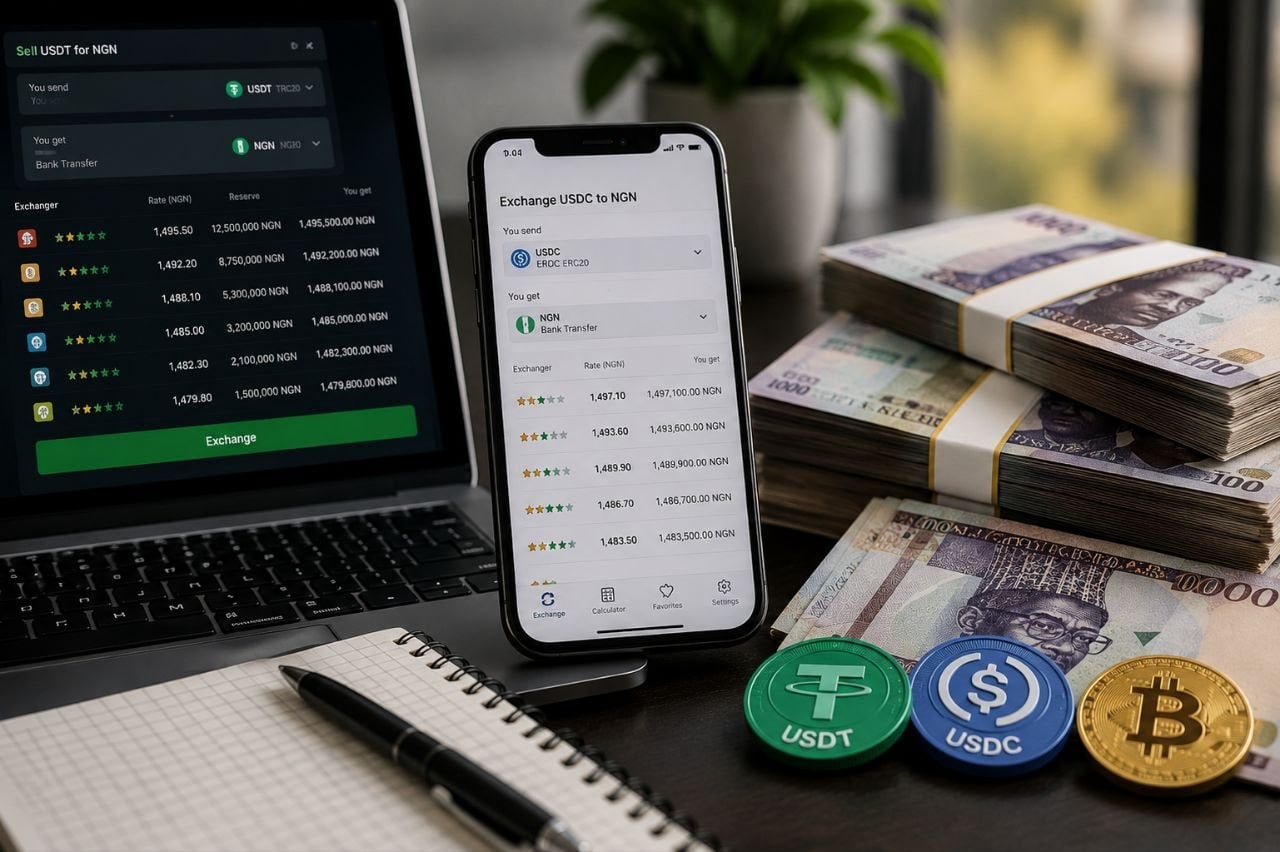
NGN is emerging as an important fiat currency in the crypto exchange market, serving as a gateway for those who would like to start building their portfolio, e.g., through USDT to naira conversions or exchanging USDC to NGN, cashing out crypto and receiving payouts to bank accounts or Visa/Mastercard cards.
Nigeria has emerged as one of Africa’s most important digital asset markets. As a result, NGN has become a prominent exchange route connecting the local currency with cryptocurrencies. Demand is driven by practical financial needs: buying USDT with naira or another cryptocurrency, for example, converting USDC to naira and, vice versa, any cryptocurrency into naira, receiving payouts via Visa/Mastercard NGN or bank transfers, and bridging local currency with international payment networks.
The key is understanding where demand exists, which exchange routes are actively used, and why businesses involved in international payments and crypto exchange should pay attention to these markets. At the center of this trend are real-world payment scenarios involving NGN settlements and exchange routes connecting USDT, USDC, and naira to Bitcoin.
BestChange provides a convenient way to evaluate this market. Users can quickly see which exchange routes are currently available and determine whether the offered terms suit their specific needs. This holistic view is particularly valuable for NGN markets, where the overall range of offers, transaction conditions, and market activity provide a much clearer picture than exchange rates alone.
Why Nigeria has become Africa’s leading crypto market
Market size
Between July 2024 and June 2025, cryptocurrency transaction volume across Sub-Saharan Africa exceeded $205 billion, representing annual growth of approximately 52%. Nigeria remained the region’s largest market, accounting for more than $92.1 billion in transaction volume over the twelve-month period. Other leading markets include South Africa, Ethiopia, Kenya, and Ghana.
In the 2025 Global Crypto Adoption Index, Nigeria ranked 6th worldwide, while Ethiopia placed 12th. Nigeria’s transaction volume was nearly three times larger than that of its closest African competitor.
Why the market keeps growing
Several structural factors are contributing to this growth. Nigeria has a large population, a median age of just 18–19 years, which means a substantial young demographic, an increasingly digital economy, and sustained demand for alternative financial services. By 2030, Africa is expected to account for approximately 42% of the global youth population, further expanding the user base for digital financial products.
Why P2P trading matters
Nigeria has consistently ranked among the world’s leading peer-to-peer cryptocurrency markets. At the same time, the growing share of large-value transactions indicates that the market is expanding beyond retail users to include larger participants.
Today, Nigerians use cryptocurrency not only for investment but also for savings, remittances, everyday payments, and holding part of their wealth in dollar-denominated assets. Consequently, demand is distributed across Bitcoin, USDT, and naira to USDC conversions rather than concentrated in a single asset.
Why demand for USDT, USDC, and Bitcoin is growing in Nigeria
Main drivers
Demand for NGN trading pairs has increased as several trends have converged: recent currency reforms, growing interest in dollar-backed digital assets, rising cross-border remittance volumes, and demand for faster settlement methods.
For small businesses, remittance recipients, and participants in international trade, this has created a clear need: quickly convert naira to USDT or USDC, transfer funds internationally, and, when necessary, convert back through a reliable exchange route, for example, TRX to naira.
Between July 2023 and June 2024, Nigeria received approximately $59 billion in cryptocurrency inflows. In 2024, stablecoins accounted for more than 43% of those inflows, demonstrating that demand is increasingly shifting toward digital dollars for payments, remittances, and value preservation.
USDT and USDC are also attractive because they can reduce transaction costs and significantly accelerate transfers compared with traditional fiat payment rails.
User behavior
Market behavior supports this trend. Nearly 60% of surveyed users in Nigeria and South Africa already use stablecoins, while 95% of Nigerian respondents said they would prefer to receive payments in stablecoins rather than naira.
Bitcoin vs. stablecoins
Despite the rapid growth of stablecoins, Bitcoin remains the primary gateway into cryptocurrency. Approximately 89% of cryptocurrency purchases made with fiat currency in Nigeria involve naira to Bitcoin conversions, while USDT accounts for roughly 7%.
This distribution reflects different use cases. Bitcoin is primarily used as an entry point into the crypto market, whereas USDT and USDC serve as practical tools for payments, remittances, and preserving value.
What NGN trading pairs are used for
Everyday and business use cases
Trading pairs with the local currency of Nigeria have become a well-established segment with clear, practical applications. One of the most common use cases is converting NGN to USDT (TRC20), allowing users to convert local currency into a dollar-pegged digital asset before transferring funds elsewhere. Another frequent scenario is selling BTC, ETH, SOL, TRX, TON, XRP, or DOGE and receiving NGN directly to a bank account or payment card. Stablecoins are also widely used as an intermediary asset between international payment systems and local payouts in naira, including transactions involving Visa/Mastercard NGN and bank transfers.
Demand within crypto/fiat trading pairs is concentrated around a few core scenarios. The most common are USDT/NGN and cashing out cryptocurrency into naira. These use cases provide the clearest picture of how actively the market is used and how these exchange routes function in practice.
The most popular exchange routes
Among the highest demand are Visa/Mastercard NGN → USDT (TRC20), Wire NGN → USDT (TRC20), and Wire NGN → Bitcoin. These are complemented by SEPA and Paysera routes, which connect international payment methods with the Nigerian naira. For example, users receiving funds from Europe can find where to exchange BTC to naira through BestChange.
Why this matters for international transfers
International remittances are particularly significant in Nigeria. In 2024, remittance inflows reached approximately $20.93 billion. As traditional cross-border transfers remain expensive, users are increasingly seeking faster and more cost-effective alternatives.
Sub-Saharan Africa continues to be the world’s most expensive region for remittances. Sending $200 to the region costs an average of 8% of the transfer amount, while bank transfers average around 15%. Against this backdrop, cryptocurrencies and stablecoins have become increasingly attractive as faster, more flexible channels for moving money internationally. As a result, exchange services that allow users to compare rates and transaction terms before initiating an exchange have become especially valuable.
Who uses these exchange routes most often
The primary users of NGN exchange routes include:
-
freelancers working with international clients;
-
families receiving remittances from relatives abroad;
-
small businesses paying overseas suppliers;
-
traders and arbitrage participants taking advantage of price differences across exchanges.
Why NGN trading pairs are integrated into everyday payments
Requirements of the local payment infrastructure
Financial infrastructure across Sub-Saharan Africa continues to develop unevenly. By 2024, approximately 58% of adults in the region had either a traditional bank account or a mobile money account.
Globally, there were more than 2 billion registered mobile money accounts in 2024, with around 1.1 billion of them located in Sub-Saharan Africa. The region remains the world’s largest mobile money market, driven primarily by East and West Africa.
Why crypto fits naturally into this environment
This ecosystem aligns naturally with cryptocurrency exchange services. Users can purchase crypto through an exchange, transfer digital assets internationally, and later cash out into local currency, and they can find numerous offers for these types of conversions on BestChange, for example, services that can exchange Bitcoin to naira. In markets where traditional banking services remain limited or costly, speed, accessibility, and the final amount received often matter more than anything else.
As a result, NGN trading pairs have become an integral part of everyday payments and cross-border transfers.
What to consider when exchanging through NGN trading pairs
Key factors to evaluate
When using NGN trading pairs, the first priority should always be the actual conditions offered for the specific exchange route. Pay close attention to the transaction terms, the exchange service’s requirements, and overall market activity for the pair you intend to use.
Before completing an exchange, it is advisable to check:
-
the exchange rate at the time of the transaction;
-
the exchanger’s available reserve;
-
minimum and maximum transaction limits;
-
the NGN payout method;
-
processing speed;
-
KYC requirements;
-
the blockchain network and any applicable network fees.
Exchange rates for naira to USDT, USDC, or Bitcoin can fluctuate throughout the day, so offers should be verified immediately before making a transaction. It’s also important to understand how fees are structured: some costs are already incorporated into the quoted exchange rate, while additional charges may be imposed by banks or payment providers.
For stablecoins and other cryptocurrencies, users should also verify the required blockchain network and the service’s address requirements before sending funds. This becomes particularly important for larger transactions, where asset verification procedures, transaction limits, and processing policies may vary significantly between exchange services.
BestChange simplifies this process by allowing users to compare exchange rates, reserves, transaction limits, and other key parameters in advance, making it easier to select the most suitable exchange service.
BestChange’s role in finding NGN exchange routes
Helping users choose an exchange service
BestChange is one of the oldest exchange rate aggregator platforms. With its 19 years of experience in the market, the platform brings together exchange offers involving the Nigerian naira in one place, making it easy to see which NGN exchange routes are currently available. This is especially valuable in a market where rates, liquidity, and available offers can change throughout the day.
Each exchange direction allows users to quickly filter out unsuitable offers and identify services that match their preferred payout method, for example, TRX to NGN, transaction size, and other requirements. The comparison table, exchanger profiles, built-in calculator, and service badges make it easy to evaluate offers at a glance and understand how transactions are processed—all without opening multiple websites.
Helping users assess and minimize risks
Risk assessment is another important consideration. Users can rely on exchanger reviews, complaint statistics, and additional service indicators when evaluating providers. For larger transactions, it’s also advisable to verify the destination cryptocurrency address using blockchain analytics tools before sending funds.
This approach streamlines the entire process for users—from evaluating an exchange route to selecting the right exchange service. If you want to see which NGN exchange options are currently available, you can compare naira to BTC or other offers on BestChange, review the exchange terms, and choose the service that best fits your needs.
Why NGN exchange routes are worth exploring now
Naira is no longer a local market
NGN has evolved well beyond a purely local currency pair. It plays an important role in converting USDC to naira today, cashing out cryptocurrency, say, within the USDT NGN trading pair, receiving international payouts, and connecting global payment systems with the local banking infrastructure through various routes.
As cryptocurrency adoption, mobile payments, and demand for dollar-denominated digital assets continue to grow, these exchange routes are becoming an increasingly established part of everyday financial activity.
What ultimately matters
When evaluating NGN trading pairs, the key question is practical: Is the exchange route available, and do its terms meet your specific requirements?
That’s why the best way to assess the market is to look at real, active exchange routes and focus on the trading pairs that consistently show strong market demand. A good place to start is by comparing offers on BestChange.
Disclaimer: This article is provided for informational purposes only. It is not offered or intended to be used as legal, tax, investment, financial, or other advice.